Why supporting Future Biotechnologists matters
"A life-changing experience.. I found my dream job"
Student, Leytonstone School, attended a Future Biotechnologist career carousel
The UK life sciences sector, valued at approximately £100 billion and employing nearly 300,000 people, is at a critical juncture (1).
While the government's ten-year Life Sciences Sector Plan sets out an ambitious vision for growth, with the UK leading the life science economy in Europe by 2030, the sector faces a profound and growing workforce challenge that threatens its global competitiveness (2).
Supporting initiatives like Future Biotechnologists is not just a matter of social responsibility; it is a strategic necessity.
A workforce in crisis
The scale of the workforce challenge is stark. Nearly half (43%) of UK life sciences organisations report struggling to find technical specialists to replace departed staff. The consequences are immediate and severe: 60% report increased workloads, 50% have faced project delays or cancellations, and 64% say skills shortages have a moderate or severe impact on their ability to innovate (3).
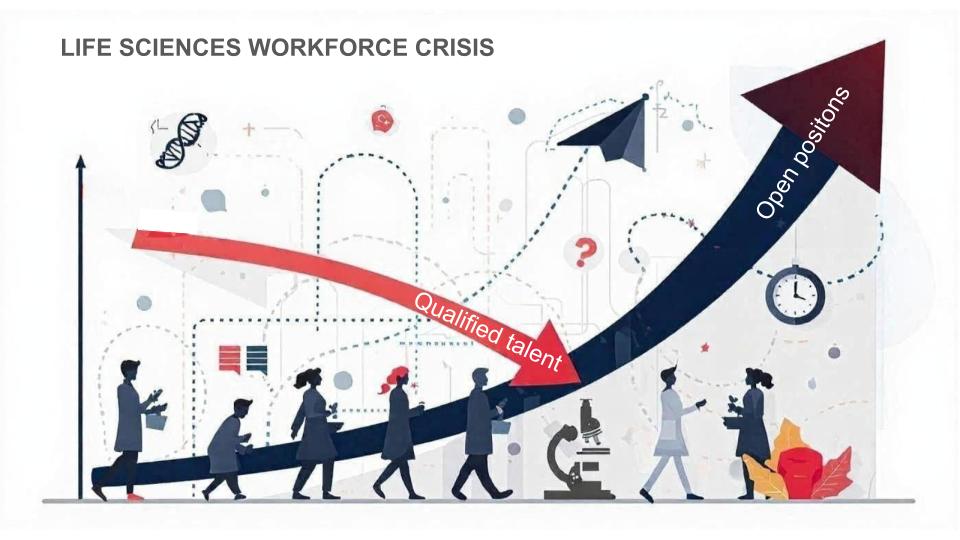
This talent crisis is compounded by an "extraordinary exodus rate" of professionals leaving for opportunities abroad, with 44% of UK life sciences professionals considering or actively planning international relocation. Almost three-quarters of professionals now believe Britain's life sciences sector is jeopardising its global standing as skilled practitioners relocate to jurisdictions offering more attractive prospects (3, 4).
A powerhouse of innovation, the life sciences sector depends, above all else, on people. Yet the pipeline of talent flowing into the sector in the UK faces a serious structural challenge: too many brilliant young minds never make it to the door.
Addressing the root causes
The workforce pressures have deep roots in the education system.
The STEM talent pipeline is uneven, with students from disadvantaged backgrounds significantly less likely to progress to post-16 STEM pathways. Those eligible for free school meals are around 44% less likely to do so than their more advantaged peers.(6) Progression to STEM qualifications varies dramatically by background: among the groups least likely to progress are female, disadvantaged pupils from White British backgrounds and from mixed White/Black Caribbean backgrounds (5).
The reason for the uneven STEM pipeline is not about potential, but about access and aspiration.
"If young girls can't see examples of themselves in the curriculum, if they can't see examples of women scientists, how can we expect them to go into STEM careers?" (Female student to the Secretary of State for Education, 2023) (6).
"You can't be what you can't see" (Marian Wright Edelman, American activist for the rights of children)
Diversity of background produces diversity of thought.
It is well established that cognitively diverse teams drive better scientific outcomes, stronger problem-solving, and more resilient organisations. Students at state-funded, non-selective schools, the vast majority of young people in the UK, are statistically far less likely to see a career in life sciences as attainable.
Without exposure to working professionals, without visibility of the breadth of roles available, and without awareness that there are routes into the sector beyond a traditional science degree, the industry risks drawing from an ever-narrowing talent pool. That is precisely the gap Future Biotechnologists aims to close.
By focusing on state-funded non-selective schools and colleges, Future Biotechnologists seeks to widen participation and improve access to opportunities for students who may not otherwise have exposure to industry professionals or networks. This contributes to a more inclusive talent pipeline, helping employers attract individuals from a wider range of backgrounds, experiences, and perspectives.
The UK's ambition to be a global life sciences leader rests on its ability to develop homegrown talent at scale.
As competition for skilled professionals intensifies internationally, the industry cannot afford to leave the potential of state-educated young people untapped.
Apprenticeships, T Levels, higher technical qualifications and direct entry roles are increasingly credible and valued pathways into the sector, but many students and their teachers don't know they exist. Future Biotechnologists deliberately shines a light on this fuller picture, helping schools and colleges give students a genuinely informed view of what a life in life sciences can look like.
Every student who discovers a passion for biotechnology, clinical research, bioinformatics, manufacturing, or regulatory affairs through an initiative like this is a future colleague, innovator, or founder.
The unique role of Future Biotechnologists
Supporting Future Biotechnologists is one of the most direct, cost-effective things any organisation in the sector can do to invest in the talent pipeline while making a tangible difference to young people who deserve the chance to be part of one of the UK's greatest industries.
Future Biotechnologists directly addresses four of the sector's most pressing workforce challenges.
Challenge 01: Building the talent pipeline at its source
The vast majority of students in the UK attend state-funded, non-selective schools. Yet they are statistically far less likely to see a career in life sciences as attainable.
Without exposure to working professionals, without visibility of the breadth of roles available, and without awareness that there are routes into the sector beyond a traditional science degree, the industry risks drawing from an ever-narrowing talent pool. That is precisely the gap Future Biotechnologists aims to close.
Through free, accessible carousel sessions and challenges - both online and in person - Future Biotechnologists connects students directly with people working across the life sciences. These aren't abstract lectures. They are vivid, real encounters with professionals who can answer the question every young person is actually asking: could someone like me do this?
Challenge 02: Demonstrating diverse routes into the sector
Not every future life sciences professional will follow a traditional academic path.
Future Biotechnologists actively highlights non-degree routes including apprenticeships and T-Levels, showing students that careers in life sciences are accessible regardless of their educational background. This is vital when programmes like King's College London's "My Life SC1ence project" have shown how hearing about unconventional career paths, like a senior lab technician who trained as a plumber before entering research, can transform young people's sense of what is possible (6).
Challenge 03: Prioritising those who need it most
The focus on disadvantaged communities and non-selective state schools is not arbitrary - it is where the talent pipeline is weakest. As the Schools White Paper acknowledges, white working-class boys are among the groups whose potential the system has failed to realise (7).
By making participation entirely free, Future Biotechnologists ensures that opportunity is not determined by ability to pay .
Challenge 04: A collective responsibility
"Medical science is one of the UK's greatest strengths… and without concerted action, the UK risks ceding ground to countries that are making workforce development a deliberate national priority" (Professor Andrew Morris, President of The Academy of Medical Sciences (8).
"We're at a pivotal moment for medical science as cutting-edge technology and innovative science come together in new ways to transform the field. Capitalising on this requires modern medical science careers that foster the right skills and enable people to thrive while building rewarding careers that help us tackle the health challenges we face today and in the future." (Dr Tony Wood, Chief Scientific Officer at GSK (8).
Supporting Future Biotechnologists is a concrete investment in the future of UK life sciences. It helps inspire the next generation, strengthens the sector's talent pipeline, promotes social mobility, and ensures that the workforce of tomorrow is equipped to meet the scientific, technological, and societal challenges ahead.
For every company that sends volunteers into a classroom, every student who discovers that life sciences offers a rewarding career beyond the traditional degree route, the UK's life sciences sector becomes stronger, more diverse and better equipped to compete globally.
References
- C Agwu (24 Dec 2025) 'From education to employment: BioSci Toolkit CIC's unique approach to EDI, access and inclusive scientific careers', Emerging Topics in Life Sciences, 9/5,
- UK Gov (16 July 2025) 'Life Sciences Sector Plan'.
- Real Staffing 'Unauthorised AI use hits 48% as UK life sciences faces skills exodus'.
- Real Staffing 'Why global mobility must be a priority for UK Life Sciences'.
- N Plaister (5 June 2025) 'Intersectionality and STEM subjects at Key Stage 5' Education Data Lab.
- C Winch (March 2024) 'Equitable Curriculum Reform: More and Diverse Women and Non-Binary Representation in The UK GCSE and A-Level Science, Technology, Engineering and Maths Curriculum', STEMETTES wHITE PAPER.
- Education Policy Institute & Centre for Education and Youth (2024) 'Progression at age 16 of young people from underrepresented background towards careers in STEM'.
- The Academy of Medical Sciences ( 4 March 2026) 'New national taskforce to secure the future of UK medical science careers',